What does it mean for a gallery to become a guest? NORITO’s presentation at SAC Gallery in Bangkok tests this proposition, moving beyond the model of temporary gallery exchanges to examine how displacement actively reshapes an exhibition.
Initiatives like Condo have reshaped the landscape of gallery collaboration, formalising models of hospitality and shared infrastructure for international exhibitions. NORITO’s project at SAC Gallery in Bangkok extends this logic, shifting focus from structural exchange to artistic process. Shaping the Chrysanthemum examines what occurs when displacement becomes an active agent in the exhibition itself – when works are not merely presented in a new space, but materially
and conceptually reshaped by it.
SAC Gallery has opened its front room as a hosting space designed to bring external practices into contact with Bangkok’s artistic ecology. This is not a partitioned presentation, but a framework for embedded production. For NORITO, this builds upon an existing dialogue begun when SAC Gallery was hosted in London in 2025. In Bangkok, the exhibition is formed from within, through local architecture, material conditions and networks, setting a different pace – one grounded in adaptation and working-with.
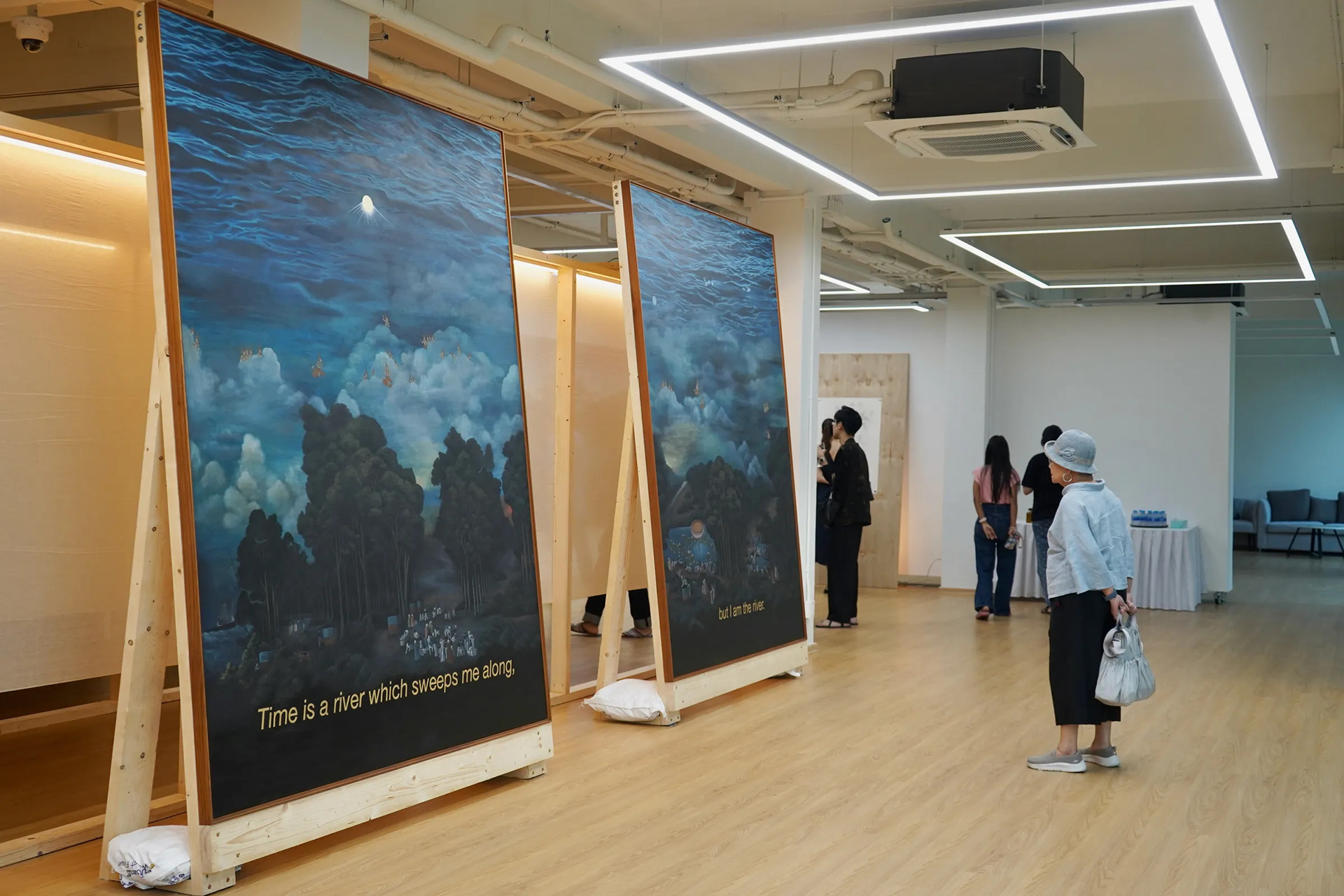
The terms are set immediately by Sirawit Chatu’s triptych, Time Is the Substance I Am Made Of (2025). Spanning six metres, it employs Western perspective and Thai gold-leaf technique, with fragments of text by Jorge Luis Borges painted onto the surface. Also drawing loosely on Khrua In Khong – often cited as the first Thai painter to assimilate Western perspectival logic into traditional visual language – the work refuses synthesis. Perspective complicates rather than resolves space; text marks time, not narrative.
At the room’s far end, Amelia Akiko Frank’s fragile graphite drawings of chrysanthemums hang from a steel strip. In Frank’s work, the flower carries its dual history as a symbol of imperial Japan and the atomic blast. In Bangkok, she introduces new steel forms that draw together the lotus and water lily – botanically proximate flowers with divergent symbolic histories. While her symbols migrate, their material realisation is tied to place, fabricated from locally salvaged steel.
Audrey Lukban’s installation undergoes a direct material translation. Originally a wooden divider with peepholes, it is rebuilt using salvaged Thai folding doors. Titled He, She, They as I Observe Them (2026) for this iteration, the concept of surveillance passes through the texture of a ubiquitous architectural fixture, becoming embedded in the local economy of materials.
Possathorn Watcharapanit extends this logic to perception. Drawing loosely from Buddhist thought, his sculptures incorporate stone from Prasat Phimai, set on mirrored aluminium. They are less representations of a site than its fragmented traces, catching partial reflections of the gallery and viewers. The work exists relationally, a shifting field where place, memory and belief appear and dissolve.
Likewise, Alexander Appleby’s paintings, rooted in UK landscapes built from early digital game aesthetics, find a new resonance. In this context, their staged, artificial quality reads less as specific scenery and more as a meditation on how space is constructed, rehearsed and maintained.Each work is subject to adaptation. They do not simply share a platform; they are reconstituted by it. This model of outward movement recalibrates what it means to bring work back. To show an artist after time spent within the conditions that shape their practice is about an understanding forged through duration, proximity and shared work – a knowledge that research alone cannot replicate.
This model of outward movement also recalibrates what it means to bring work back. To show an artist in London after time spent within the conditions that shape their practice is not merely about visibility. It is about an understanding forged through duration, proximity and shared work – a knowledge that research alone cannot replicate. When NORITO presents a duo exhibition by Chatu and Lukban in London this March, it will be informed by precisely this embeddedness.

